
Best Materials for Custom Counter Mats: PVC vs. Rubber vs. SBR vs. EVA Foam
Selecting the right material for custom counter mats is not a cosmetic decision—it directly impacts durability, print quality, safety, and long-term return on investment. While all counter mats serve the dual purpose of protection and branding, the material determines how well they perform in real-world conditions.
This analysis breaks down the four most commonly used materials—PVC, rubber, SBR, and silicone—so you can make an informed, use-case-driven decision.
1. PVC (Polyvinyl Chloride)
PVC is one of the most widely used backing materials for custom counter mats, particularly in customer-facing environments.
Key Characteristics
- Lightweight and cost-effective
- Water-resistant and easy to clean
- Can be manufactured with a clear vinyl top layer for insert graphics
Advantages
- Excellent print quality: Ideal for detailed branding, logos, and promotional messaging
- Low cost: One of the most economical options for bulk orders
- Versatility: Suitable for all retail counters including banks and service desks
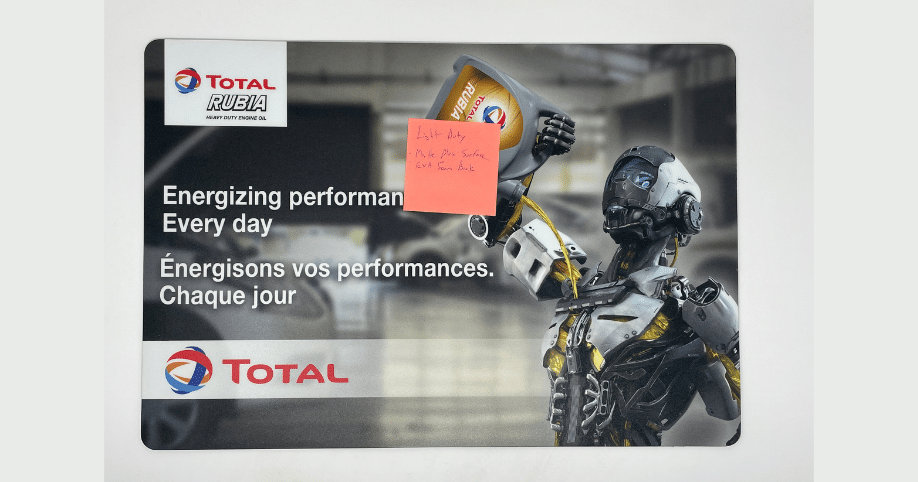
Limitations
Not as slip-resistant as rubber-based materials
Best Use Cases
- Point-of-sale (POS) counters with traditional static messaging
- Promotional mats with frequently updated inserts (insert style)
- Indoor environments with moderate traffic
2. Natural Rubber
Natural rubber is a premium material known for its durability and grip, making it a strong choice for high-traffic environments.
Key Characteristics
- Dense, flexible, and highly resilient
- Naturally slip-resistant
- Absorbs impact and reduces movement
Advantages
- Superior grip: Keeps mats firmly in place during customer interaction
- Thickness Options: 1/16”, 1/8”, 1/4”
- High durability: Withstands constant use and pressure
- Comfort: Provides cushioning for employees working long hours at counters
Limitations
- Higher cost compared to PVC
- Heavier, which may increase shipping and handling costs
- Limited print clarity compared to laminated PVC surfaces
Best Use Cases
- High-traffic checkout counters
- Environments requiring stability (e.g., parts counters, automotive, farm equipment)
- Long-term installations where durability is critical
3. SBR (Styrene-Butadiene Rubber)
SBR is a synthetic rubber that offers a balance between cost and performance. It’s commonly used as a backing material in many counter mats.
Key Characteristics
- Synthetic rubber with consistent properties
- Resistance to wear and abrasion
- Mid-Range price point
Advantages
- Cost-performance balance: More affordable than natural rubber
- Good traction: Provides reliable anti-slip performance
- Resilient under repeated use
Limitations
Slightly less eco-friendly due to synthetic composition
Best Use Cases
- Mid-range retail and service environments
- Businesses needing durability without premium cost
4. EVA Foam
EVA foam is a popular material often used when the intended life of the counter mat is 2 years or less
Key Characteristics
- Very light material that is stiff / rigid
- Non-porous and resistant to moisture
- Maintains shape and performance under extreme conditions
Advantages
- Cost Effective: Ideal for customers with a limited budget
- Hygienic: resistant to mold
Limitations
- Slightly less slip resistant than other options
- Only 1 thickness available: 1/8”
- Can’t be rolled for shipping or storage (must remain flat)
Best Use Cases
- Calendar counter mats
- Reference guides
Side-by-Side Comparison
| Material | Cost | Durability | Print Quality | Grip / Slip Resistance | Best For |
|---|---|---|---|---|---|
| PVC | Low | Excellent | Excellent | Moderate | Promotions, POS branding |
| Rubber | High | Excellent | Excellent | Excellent | High-traffic counters |
| SBR | Medium | Good | Excellent | Excellent | Balanced performance |
| EVA | Low | Good | Excellent | Good | Calendars, Reference |
How to Choose the Right Material
The “best” material depends on your operational priorities:
- Choose PVC if your primary goal is high-impact branding at low cost
- Choose natural rubber if you need maximum durability and stability
- Choose SBR if you want a balanced, cost-effective solution
- Choose EVA if your environment demands 1-2 year life span
Final Takeaway
Material selection for custom counter mats is ultimately a trade-off between durability, and cost.
For most customer-facing applications, PVC or SBR-backed mats with a high-quality printed surface will deliver the best balance. However, in demanding environments—whether high-traffic retail or long-term durability—investing in rubber can significantly improve longevity and performance.
Choosing correctly upfront ensures your counter mats not only look good but continue to perform where it matters most: at the point of interaction with your customers.