
How Are Custom Counter Mats Made?
Custom counter mats may look simple on the surface, but their production involves a precise combination of material science, printing technology, and manufacturing processes. The goal is to create a product that is simultaneously durable, functional, and visually compelling—capable of withstanding daily use while maintaining brand clarity.
Here’s a step-by-step breakdown of how custom counter mats are typically made.
1. Design & Pre-Press Preparation
Every custom counter mat begins with artwork.
Key Steps
- Graphic design creation: Logos, messaging, product images, and layout are developed to fit the mat’s dimensions
- Color calibration: Colors are adjusted to match brand standards (often using Pantone or CMYK profiles)
- Proofing: A digital proof is reviewed and approved before production
Technical Considerations
- Resolution must be high enough (typically 300 DPI) to ensure crisp printing
- Bleed areas are added to account for trimming
- Layout must account for any die-cut or custom shape
At this stage, the focus is on ensuring that what’s printed will look sharp and accurate in the final product.
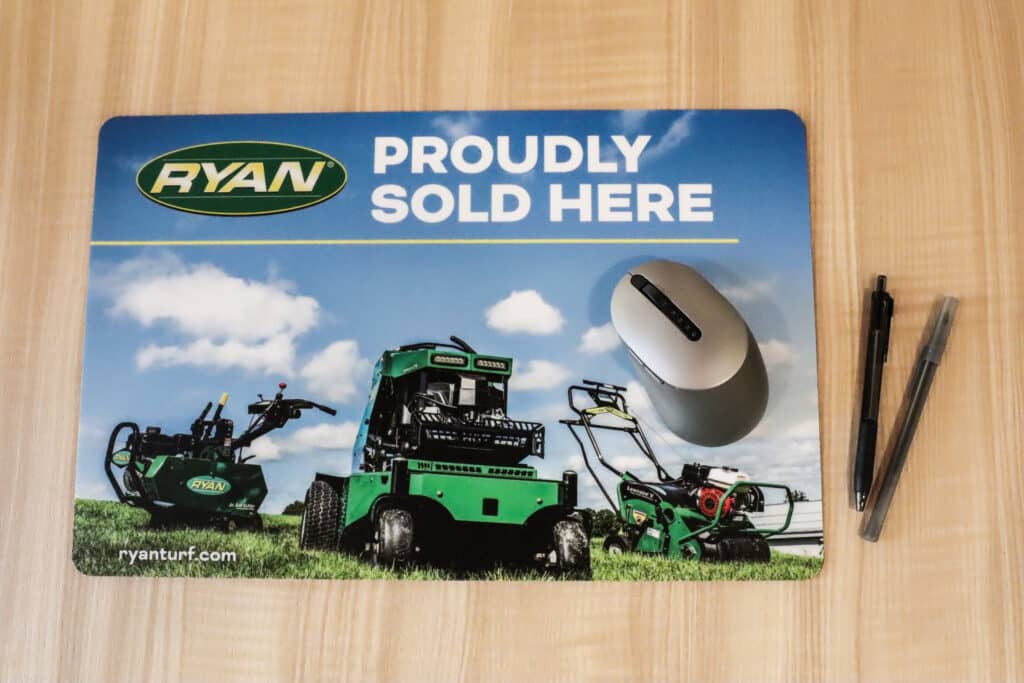
2. Material Selection
The next step is choosing the appropriate material based on the intended use.
Common Configurations
- Natural Rubber, SBR, PVC or EVA backing with clear vinyl overlay (for insert-style mats or traditional and TUFF Mat style)
- Fabric top with rubber backing (for dye-sublimated mats)
Material choice determines:
- Print method compatibility
- Durability and lifespan
- Grip and flexibility
- Cost structure
This is a critical decision point because it affects both performance and appearance.
3. Printing the Graphics
Once the design and material are finalized, the artwork is transferred onto the mat surface using one of several printing methods.
A. Offset or Digital Printing
- Graphics are printed onto paper or vinyl
- Inserts are placed beneath a clear PVC or vinyl top layer for Insert Style
- Provides sharp, vibrant visuals with strong protection
B. Dye-Sublimation (Fabric Surface Mats)
- Heat and pressure transfer dye directly into polyester fabric
- Produces high-resolution, full-color images that won’t peel or crack
- Common for Gaming Mats, Mouse Pads and Desk Mats
C. Digital UV Printing
- Ink is printed directly onto the surface and cured with UV light
- Fast and flexible for short runs or variable designs
Each method balances cost, durability, and visual fidelity differently.
4. Lamination or Surface Sealing
For many traditional hard surface and TUFF Mat counter mats a protective top layer is added.
Purpose
- Shields graphics from scratches, spills, and wear
- Enhances color depth and clarity
- Extends product lifespan
This layer is typically:
- Heat-laminated onto the printed surface
- Specify Textured or Smooth // Matte or Gloss depending on final use
In fabric mats, the dye-sublimation process itself embeds the image into the fibers, eliminating the need for a separate laminate.
5. Backing Application
The backing provides structure, grip, and durability.
Common Backing Materials
- Natural rubber: Premium grip and flexibility
- SBR (synthetic rubber) or PVC: Cost-effective and durable
- EVA foam: Lightweight with moderate grip
Process
- The printed top layer is bonded to the backing using heat and pressure
- Adhesives or vulcanization techniques ensure a strong, long-lasting bond
This step ensures the mat stays in place during use and resists curling or
6. Cutting & Shaping
After lamination and bonding, mats are cut to size.
Methods
- Die-cutting: for high-volume production with consistent shapes
- CNC cutting: Provides precision for custom or complex shapes
- Manual trimming: Used for small runs or specialty orders
Edges may be:
- Straight (standard rectangular mats)
- Rounded (to prevent lifting and wear)
- Custom-shaped (to match logos or unique designs)
- Accuracy here is critical for both aesthetics and
7. Quality Control
Before shipment, mats go through inspection.
Checks Include
- Print accuracy and color consistency
- Proper alignment of layers
- Edge quality and dimensional accuracy
- Adhesion strength between layers
Defective units are removed to ensure only production-ready mats reach the customer.
8. Packaging & Shipping
Finally, mats are:
- Cleaned and stacked or rolled
- Packaged to prevent creasing or damage
- Shipped in bulk or individually depending on order size
Proper packaging is especially important for maintaining flatness and presentation upon arrival.
Variations in Manufacturing
Not all counter mats are made the same way. Variations depend on:
- Volume (short-run digital large-scale offset production)
- Customization level (standard sizes fully custom shapes)
- End-use environment (retail, hospitality, industrial, healthcare)
Higher-end mats typically involve more advanced materials and multi-layer construction, while budget options streamline the process to reduce cost.
Final Takeaway
Custom counter mats are the result of a multi-step manufacturing process that integrates design precision, material engineering, and print technology.
What appears to be a simple promotional item is actually a carefully constructed product designed to perform under constant use while delivering consistent brand visibility.
Understanding how they’re made allows businesses to make better decisions about materials, print methods, and overall quality—ensuring the final product aligns with both operational needs and marketing objectives.